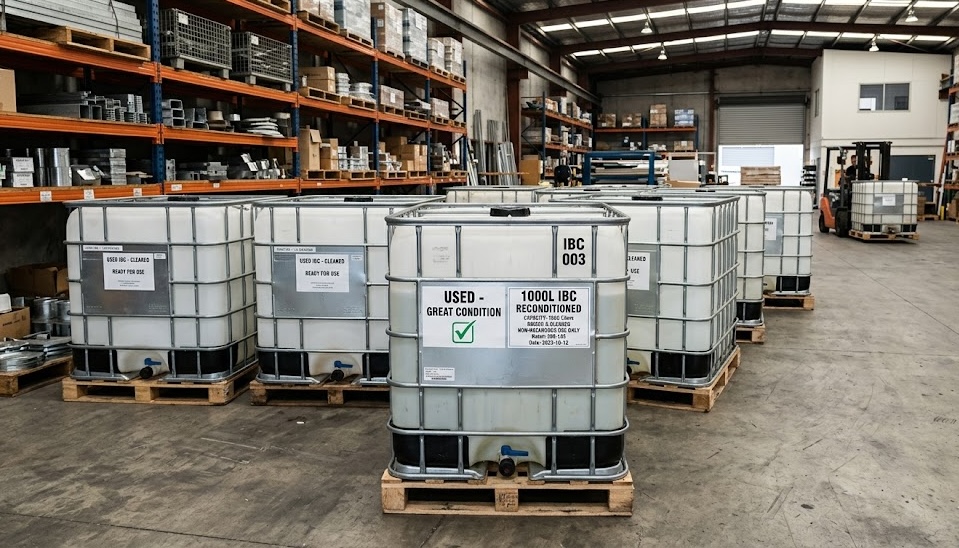
Our four-stage process
- Triage & cage inspection. Every inbound tote gets a chalk mark and a grade. Bent cages go to the straightening jig. Cages with fractured welds go to recycling.
- Pressure wash. Cold rinse → hot rinse (180°F) → optional caustic detergent loop. Three stations running in parallel. Wash water reclaimed through our closed-loop settling tank.
- Pressure test. Each tote pressurized to 3 PSI and held for 10 minutes, matching UN/DOT specification. Any seep sends the unit back for rework or rejection.
- Re-label & pack. Fresh UN/DOT label printed with cage serial and recondition date. New tamper seal on the fill cap. Ready for outbound.
For customer-owned totes
We also recondition totes that belong to you. Typical use case: a food blender or co-packer that owns a fleet and wants them cleaned between products.
- Drop-off at the yard OR pickup via our trailer
- Clean record and test certificate per tote
- Per-tote pricing: ~$45 (standard HDPE), ~$60 (food-grade), ~$95 (caged steel)
- Turnaround: 24–72 hours depending on queue
What reconditioning can't fix
No amount of cleaning turns a chemical-contaminated bottle into a food-grade one, and no amount of straightening saves a cage with fractured welds. When we find either, we redirect the tote to rebottling, fabrication, or recycling. The point of the yard is to find the right second life — not to force one.
Certification details
Our UN/DOT re-labeling process complies with 49 CFR 178.801 for intermediate bulk containers. Each tote gets a certificate that traces back to the pressure-test batch record and the cage serial.
Before and after: what reconditioning actually looks like
We can't show you photos on this page, but here's what the transformation looks like at each stage — described in enough detail that you'll know what to expect when your totes come back from us:
Before: Inbound tote (typical)
Chalky white bottle with a faint pink tint from previous contents (fruit juice concentrate). Label residue on two sides. Three stickers partially peeled. Valve handle slightly loose with a slow drip. Cage has two dings on the front cross-members — dents about 15mm deep. Pallet has a cracked stringer on the right side. Overall: dirty, functional, needs work.
After: A-grade reconditioned
Bottle is uniformly white, no staining, no residue. All labels and sticker residue removed. New valve installed with fresh Viton gasket — zero drip. Cage dings straightened to within 3mm of original profile. Pallet stringer repaired with a galvanized sister board. Fresh UN/DOT label with chalk serial, recondition date, and facility ID. Sealed with tamper-evident fill cap ring.
Failure modes we catch during reconditioning
Our four-stage process is designed to catch problems that would otherwise make it to your dock. Here are the most common failure modes we intercept:
- Hairline stress cracks (bottle base): Visible only under angled light. Caused by repeated stacking load or chemical stress. Caught during visual inspection. These totes go to rebottling or recycling — never to a customer.
- Valve seat erosion: The internal ball seat wears out after 50–100 cycles, causing a slow drip even when closed. We replace every valve on A-grade totes to eliminate this risk entirely.
- Cage weld fractures: Microscopic cracks at cage corner welds — usually caused by forklift impact transmitted to the weld joint. We catch these by tapping the weld with a hammer and listening for a dead (non-ringing) sound. Fractured welds mean the cage goes to recycling.
- UV embrittlement (hidden): A bottle that looks fine from the outside but has become brittle from UV exposure. We test by pressing a thumbnail into the bottle wall — if the plastic cracks or flakes instead of denting, it is compromised. Common on totes that have been stored outdoors without cover.
- Gasket contamination: Old gaskets absorb flavors and chemicals over time. A gasket that previously sealed a tote of solvent can contaminate a food-grade product. We replace all gaskets on food-grade track totes as a matter of policy.
- Pallet rot (wood): Internal rot in wooden pallet stringers — the outside looks fine but the stringer is soft and weak. We probe with an awl. Rotted stringers get replaced with new timber before the tote ships.
- Thread damage (fill port): Stripped or cross-threaded S60x6 or S56 threads on the bottle neck. Usually caused by a customer overtightening with tools. Minor thread damage can be chased with a die; severe damage means the bottle cannot be reliably sealed and goes to recycling.
Testing equipment specifications
- Pressure test manifold: Custom-built manifold that simultaneously tests up to 4 totes. Each line has an independent pressure gauge (0–15 PSI, 0.1 PSI resolution) and a shut-off valve. Gauges are calibrated annually against a NIST-traceable reference.
- Pressure source: Oil-free air compressor, rated to 8 CFM at 90 PSI. Regulated down to 3–5 PSI for IBC testing. Oil-free is critical — oil contamination in compressed air can invalidate food-grade certification.
- Hot water system: Natural-gas-fired water heater, 100-gallon capacity, 180°F continuous supply. Flow rate: 12 GPM to each wash station. Temperature is monitored with an inline thermocouple — wash water below 160°F is not effective for food-grade cleaning.
- Caustic detergent system: Metering pump adds NSF-approved alkaline detergent (sodium hydroxide-based, pH 12–13) at a concentration of 2–4% by volume. Contact time: 10 minutes with manual agitation (spray wand inside the bottle).
- Cage alignment jig: Steel-frame fixture that holds a cage at four corner posts and measures squareness with dial indicators. Tolerance: ±3 mm diagonal difference. Cages that exceed tolerance are corrected with a 12-ton hydraulic press mounted at the triage bench.
- Borescope (steel totes): 6 mm articulating video borescope with LED illumination. Used to inspect the interior of caged-steel totes for pitting, scaling, and coating delamination. Images are archived per chalk serial.
Reconditioning throughput and capacity
- Daily capacity: 25–35 totes per day across three wash stations, depending on contamination level and cleaning protocol.
- Annual throughput: Approximately 6,200 totes per year (reconditioning only, not counting rebottling or recycling).
- Turnaround for customer-owned totes: 24–72 hours from drop-off to pickup-ready, depending on queue depth.
- Staffing: The reconditioning line runs with 3–4 crew members: one at triage, one at wash, one at test/label, and one floating as needed.