Charlotte IBC Totes

Standard IBC Totes

The workhorse: 275 & 330 gallon caged HDPE.

275 gal330 galHDPEUN/DOT ratedReconditionedUsed

If you need one IBC, this is probably the one. Composite HDPE bottle, galvanized steel cage, 2" ball valve, steel or wood pallet. We keep a few hundred on the lot at any given time.

Price my load · 2 minutes

Fill this and our yard manager replies the same business day.

US/Canada format: (555) 123-4567
US zip (12345) or Canada (A1A 1A1)

By submitting you agree we may email you once about your request.

What a standard tote is (and isn't)

"Standard" is our shorthand for the 275- or 330-gallon intermediate bulk container you've seen on the back of every factory loading dock in America. A composite HDPE inner bottle, a welded galvanized steel cage, a 6" fill opening on top, a 2" ball valve at the bottom, all on a 40" × 48" pallet.

What it isn't: food-grade (unless we explicitly flag it as such), stainless, chemical-rated, or suitable for long-term drinking water storage. If you need any of those, check our food-grade, stainless, or rebottled options.
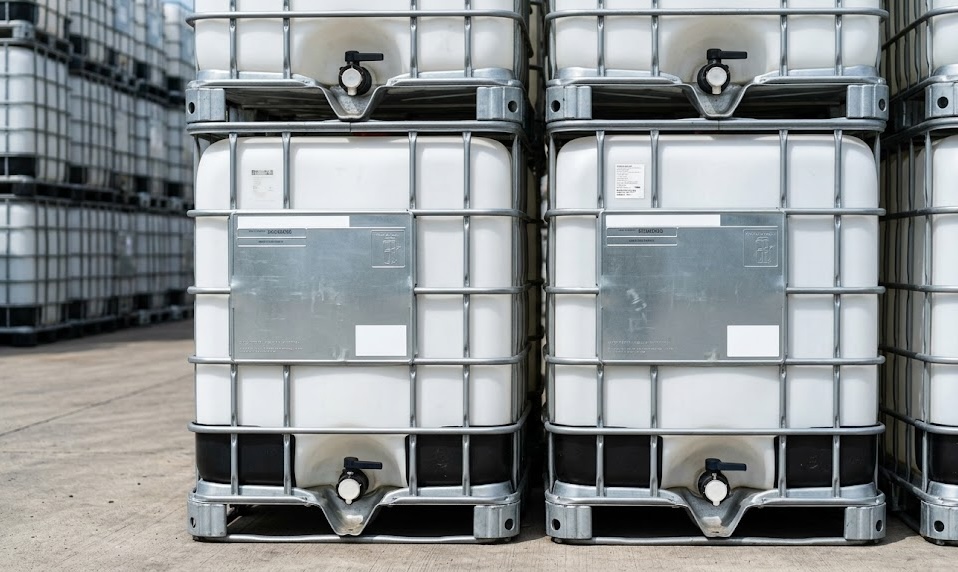
Close-up of standard IBC totes showing cage crossmembers, HDPE bottle, and valve detail

Standard composite IBC — cage, bottle, valve

The galvanized steel cage protects the HDPE bottle inside. The 2" ball valve at the bottom is the most-replaced part on any tote.

The 275 vs 330 question

Most of North America runs on the 275-gallon size (1,040 liters). It fits two per euro-pallet lane in most warehouses and stacks two-high without a second thought. The 330-gallon (1,250 liters) is taller by about six inches and heavier when full — useful when you're trying to squeeze more volume onto the same floor footprint, less useful if your forklift or doorway is height-limited.

Typical dimensions

  • 275 gal: 48" × 40" × 46" H — empty ~120 lb
  • 330 gal: 48" × 40" × 53" H — empty ~135 lb
  • Full weight (water): 275 gal ≈ 2,400 lb · 330 gal ≈ 2,880 lb
  • Valve: 2" NPT ball valve (other options available — see accessories)
  • Top opening: 6" threaded fill cap with gasket

Our three grades of "standard"

  1. A-grade: Pressure-washed, pressure-tested, no visible cage damage, original valve replaced. Ships with a current UN/DOT label.
  2. B-grade: Cleaned, functional, minor cosmetic wear. Valve may be original or aftermarket. No UN re-label.
  3. As-is: Sold exactly how we got it — some cleanup may still be needed. For rework projects only.

Inspection before you buy

We encourage every in-person customer to kick the cages. Look for:

  • Any seep around the valve or drain
  • Cage cross-members that are bent or pushed inward
  • Yellowing or brittleness on the bottle (a UV tell)
  • The bottom-pallet stringers (for forklift damage)

If you're buying remote, we'll photograph each tote before it ships. That's our default — we'd rather you know what you're getting than show up disappointed.

Detailed material specifications

HDPE bottle

  • Material: High-density polyethylene (HDPE), blow-molded, FDA-approved resin (21 CFR 177.1520)
  • Wall thickness: 3.5 – 4.5 mm (nominal). Thicker at bottom corners due to blow-mold geometry.
  • Color: Natural (translucent white) is most common. Opaque white and blue exist but are less frequent in our inventory.
  • UV resistance: Virgin HDPE is moderately UV-resistant but degrades over time with direct sun exposure. Expect visible yellowing and surface embrittlement after 2–3 years of continuous outdoor exposure without shade. For outdoor storage, we recommend an opaque cover or UV-stabilized paint.
  • Temperature range: -40°F to 140°F for continuous service. Short excursions to 160°F are tolerable for cleaning. Above 180°F, the bottle begins to soften and deform under load.
  • Chemical compatibility (HDPE): Excellent for water, most acids (dilute), most bases (dilute), alcohols, many solvents. Poor for chlorinated solvents, aromatic hydrocarbons, strong oxidizers, and concentrated nitric acid.
  • Permeation: HDPE is slightly permeable to some solvents and flavors over long storage periods. For flavor-sensitive food applications, rebottled (new HDPE) is recommended.

Steel cage

  • Material: Carbon steel, welded tube construction
  • Finish: Hot-dip galvanized (zinc coating, typically 40–60 microns)
  • Tube diameter: 20 – 25 mm OD (varies by manufacturer)
  • Wall thickness (tube): 1.2 – 1.8 mm
  • Cross-member count: Typically 8 horizontal bars per side, 4 sides = 32 total cross-members
  • Corner post design: Vertical tubes with welded top and bottom brackets for stacking load transfer
  • Stacking load rating (static): 4,000 – 6,000 lb per cage (manufacturer dependent). Derated to 2,500 lb for used cages in our grading system.

Pallet

  • Wood pallet: 48" x 40" GMA standard, typically pine or mixed hardwood, 4-way entry
  • Steel pallet: 48" x 40", galvanized channel steel, 4-way entry, adds ~28 lb to tare weight
  • Composite pallet: Occasionally seen — plastic and wood hybrid, treated as wood for handling purposes
  • Fork pocket height: 3.5" standard clearance between bottom stringers and ground

Chemical compatibility chart (common contents)

SubstanceHDPE (standard)Caged steelStainless 316L
Water (potable / process)ExcellentGoodExcellent
Syrups / sugarsExcellentGoodExcellent
Vegetable oilsExcellentGoodExcellent
Dilute acids (< 10%)GoodPoorExcellent
Concentrated acidsFairNot recommendedGood (depends on acid)
Dilute bases / causticsExcellentFairExcellent
Alcohols (ethanol, IPA)GoodGoodExcellent
Chlorinated solventsNot recommendedGoodExcellent
Aromatic solvents (toluene)Not recommendedGoodExcellent
Diesel / fuel oilNot recommendedGoodExcellent
Bleach / hypochloriteFair (short term)PoorFair
Agricultural chemicalsGoodFairExcellent

This chart is a general guide, not a specification. Always verify chemical compatibility for your specific concentration, temperature, and exposure duration. We can advise — email us with the details.

Storage guidelines

  • Outdoor storage: Keep totes off bare ground (pallets or gravel). Avoid direct sunlight on HDPE bottles — UV causes yellowing and embrittlement within 2–3 years. Cover with a tarp or park under a roof.
  • Indoor storage: Stack two-high maximum. Ensure pallet alignment — misaligned stringers can damage cage cross-members. Maintain 4" clearance from walls for forklift access.
  • Empty storage: Leave the valve open and the fill cap loosened to prevent vacuum collapse in temperature swings. Invert the tote if practical to drain residual moisture.
  • Temperature extremes: HDPE can freeze without damage (it becomes more brittle, so avoid impacts). Above 120°F ambient, contents may expand — leave 5% headspace in any filled tote.
  • Pest control: Rodents occasionally nest in empty tote pallets. Keep storage area clean, fill caps closed, and inspect before filling if totes have been stored for 60+ days.

Maintenance tips for long life

  • Rinse after each use — even with water, biofilm can form in 48 hours.
  • Replace the valve gasket every 3–4 fill cycles, or immediately if you see dripping.
  • Check cage cross-members for bending after every forklift interaction.
  • Tighten the fill cap snugly but not overtight — stripping S60x6 threads is the most common homeowner mistake.
  • If the bottle develops a stress-white spot, stop using it for liquid containment — it is a precursor to cracking.
  • Touch up bare-steel spots on the cage with a zinc-rich cold galvanizing spray to prevent rust creep.

Common failure modes (what kills a tote)

  1. UV embrittlement: The #1 cause of HDPE bottle failure. Bottles left in direct sun for 3+ years become brittle and crack under fill pressure. Prevention: shade or cover.
  2. Forklift puncture: Overshoot with the forks = punctured bottle or bent cage. Prevention: use a spotter, fork slowly.
  3. Chemical stress cracking: Certain chemicals (concentrated surfactants, some solvents) cause HDPE to stress-crack at the base. Prevention: verify compatibility before filling.
  4. Valve failure: Ball valves wear out after 50–100 open/close cycles. The seal degrades, and the handle loosens. Prevention: replace valves proactively, not reactively.
  5. Cage fatigue: Cross-members bent inward from stacking or impact. Once a cross-member is kinked (sharp bend), it cannot be straightened safely — the metal is work-hardened and will fracture.
  6. Freeze/thaw cracking: Water-filled totes left outdoors in sub-20°F weather can crack as ice expands. Prevention: leave headspace, drain in winter, or add non-toxic antifreeze for non-potable applications.

How we compare to national reconditioning houses

Large national IBC reconditioners move 50,000+ totes per year through automated wash lines. We move about 6,000 through a hands-on, human-inspected process. The tradeoff:

  • We inspect every cage by hand. A bent cross-member that an automated line might miss gets caught at our triage bench.
  • We photograph every outbound tote. You see exactly what you are buying before it ships.
  • We price by condition, not by SKU. A near-mint A-grade costs more than a cosmetically rough B-grade, but the B-grade is still a fully functional tote at a better price.
  • We run shorter supply chains. Most of our totes travel under 200 miles from source to customer, keeping freight carbon and cost down.
  • We don't landfill anything. National houses typically landfill 5–10% of inbound totes. Our rate is zero.
Get
a Quote